

Thinking Visually (as an author)
How I approach writing as a non-illustrator

Vicky and I have been thinking up lots of new topics for the coming months that we’re excited to share. But we’d also love to hear from you: what would you like us to cover in the future?
Now, on to today’s post. As writers it can be tricky for us to visualize how our words will fit on the page and how the illustrator will interpret our story. And a lot of that is out of our hands, as it should be. But there are some things we can do to help make sure our stories work well as a picture (or other illustrated) book.
We need to think visually.
Variety is the spice of life
And the spice of picture books. You need to give the illustrator lots of opportunities to draw different things to keep our young readers engaged. Kids love pointing out things in the illustrations and if everything takes place in the same place, at the same time, with the same characters, they’ll have a lot less fun engaging with the book.
Time
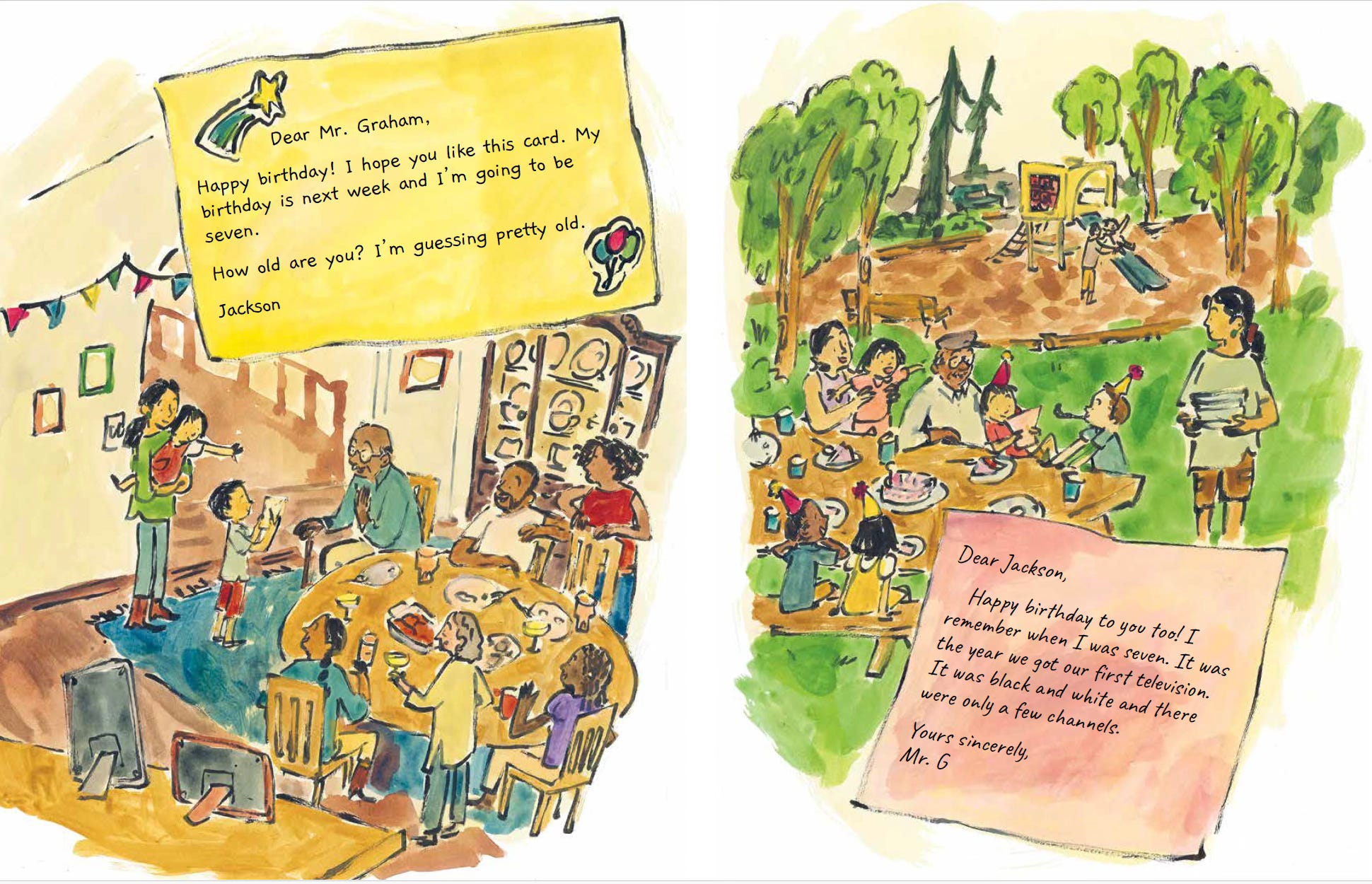
In Dear Mr. G the story takes us through seasons. We start with roses blooming in spring, move into fall and winter, and then back to the roses blooming again.
This is clear from my text and I didn’t need to add art notes for the fantastic Gracey Zhang to interpret this (more on art notes in a bit).
Try it: Think about how time moves in your story. When does your story take place? Is everything in one morning? Does it take place over a day? Over a season or more?
Some stories take place over just a few minutes so other techniques are needed to ensure there’s variety in the spreads.
Setting
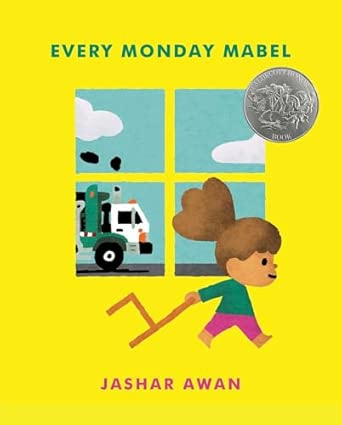
In Every Monday Mabel by Jashar Awan the story takes place (mostly) at Mabel’s house over the course of just a few minutes. But the settings are varied throughout the spreads. Now, Jashar has the advantage here of also being the illustrator but I think it’s a great example of how a story can be from just a moment in time, set at a house, but still have lots of variety in the settings. This is one of my favorite recent picture books!
Travis Jonker wrote a great breakdown of this book and why it’s so successful:

Try it: Where is your story set? At a home? A school? More than one place? Even if it only takes place in one location, there can be some variety in the settings just like in Every Monday Mabel.
To paginate or not to paginate, that is the question
I find pagination can be very useful when I’m working with a very tightly structured book. For example, my upcoming board book series is interactive and there is an action before each page turn. For that reason I paginated the manuscript so I could make sure I had enough actions for a whole book.
Another reason to paginate is to closely examine your page turns. When the reader turns the page, is there action? Is there a change of scene? Is the next spread visually different to the previous one? Maybe you want to add a wordless spread (you can totally do that as an author, use an art note).
Try it: Take your latest manuscript and paginate it. Remember, picture books don’t start at page 1. Often, one scene is one spread but not always depending on what you want to emphasize or what you want readers to linger over.
Note: some editors and agents don’t like pagination. You might decide to remove it before submission.
Art notes
Ah, the perennial question for us authors. Should we include art notes?
I tend to write a lot of art notes in early drafts. Then by the time I’ve revised, I’ve realized I don’t really need them so I take them out. The general consensus is that only include them if they’re essential for understanding the story. If an editor won’t understand your story without them, leave them in. And if you are visualizing a wordless spread you definitely need to add one. You can also use a global art note if there’s something important the editor needs to know up front about your vision for the book. And if your book is nonfiction, art notes or references might be helpful for the illustrator to receive.
It could be that the editor then deletes them all before passing the manuscript on to the book’s illustrator to allow them room to do their magical thing. And that’s okay!
For my middle grade nonfiction, Top Secret Animals, I wrote a number of art notes as a lot of the humor in this book comes from the illustrations (Blythe Russo is amazing). I don’t think my vision for the book would have come across to my editor without them.
Debbie Ridpath Ohi went into lots of details about art notes in this post:

Dummying
This is a bigger subject that Vicky is going to dive into soon. This is where you’ll really be able to see where your page turns fall, your variety in settings, and how time moves through your book.
Final tip
Head to the library and pick up a stack of new picture books. Analyze them with the above in mind. If it’s been a while since you’ve typed up the text from a picture book, give it a try. How does the author’s text ensure there’s visual variety in the book? What do you notice about how the passage of time, settings, and page turns?
Over to you: how do you think visually as an author? Any other tips?
Informative as always!
I worked in video production as part of my career as a marketing professional. It has helped me to visualize my stories as videos or children’s tv cartoons. For the kind of things I like to write like my picture book, Spot or Not, and my latest, Wally’s Grab and Run, I saw the story unfolding visually as I wrote it. It’s funny how our brain can be trained. I’m starting to work on a middle grade novel, which will not have images, so I am still trying to keep in mind the story now as a future film and seeing it unfold as I’m writing. In another life, I would’ve been a film Director.